
The Arctic Front
How Finland is preparing for war with Russia

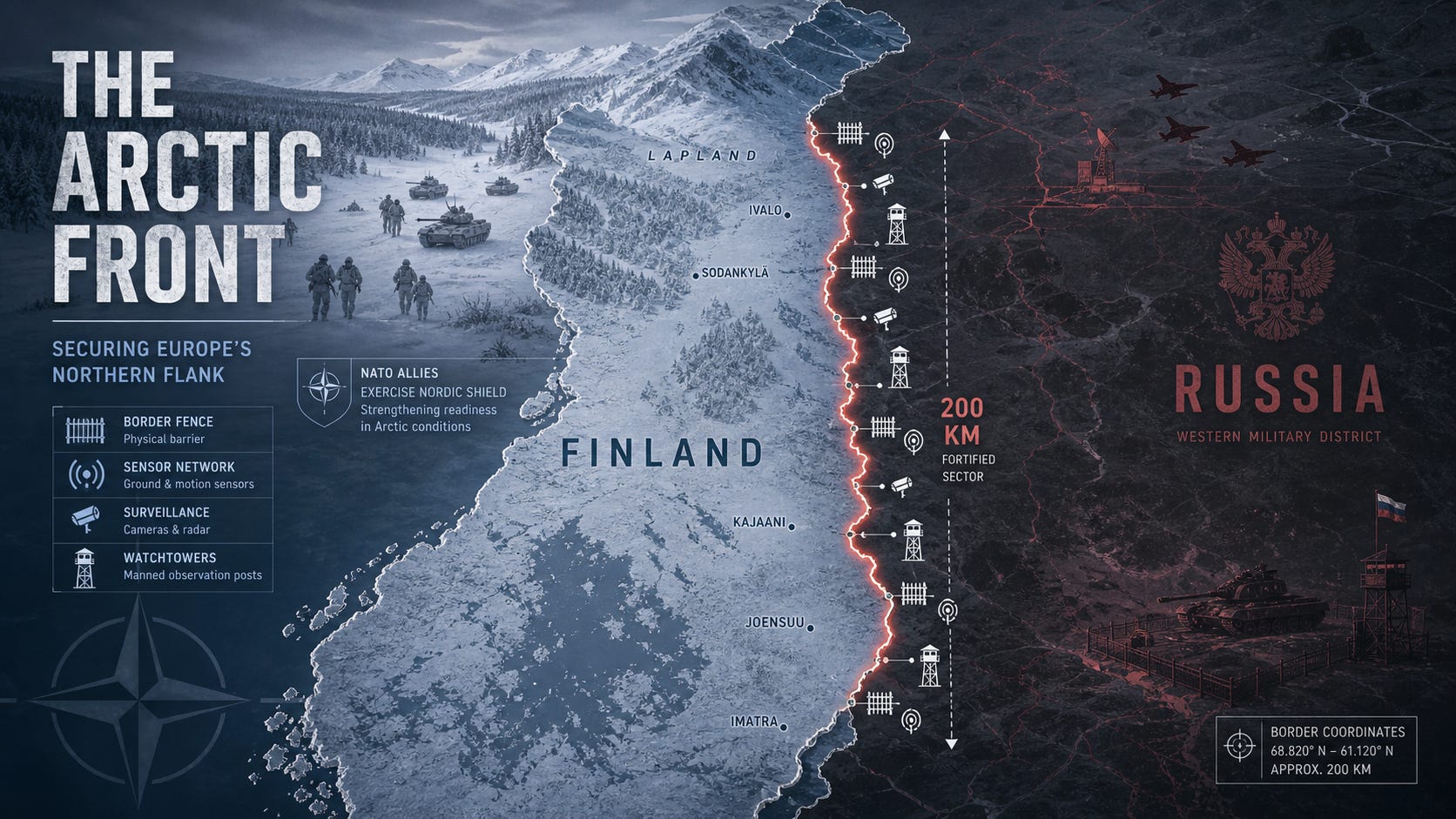
Finland is no longer preparing for ambiguity on its eastern border. It is preparing for conflict conditions.
Since 2023, Helsinki has progressively hardened its 1340 km frontier with Russia through a combination of physical barriers, legal authorities and military integration. What began as a response to so-called instrumentalised migration has evolved into a broader deterrence posture aligned with North Atlantic Treaty Organisation (NATO) northern flank. The closure of all land border crossings , the extension of the emergency border legislation and the construction of a selective but technology dense fence all point to the same conclusion: Finland now assesses that long-term confrontation with Russia is plausible and that the border must be treated accordingly.
This shift is not simply defensive. It reflects a deeper strategic recalibration in which Finland has moved from managing a difficult neighbour to actively shaping the security architecture of the High north.
Key Judgements
KJ1: Finland has transformed its eastern border into a layered deterrence system rather than a conventional control line. The planned 200km fence, incorporating sensors, cameras, AI- enabled surveillance and rapid infrastructure is designed to provide early warning and delay, not complete denial. It reflects an assumption that future pressure maybe be fast moving, deniable and designed to exploit gaps in response time.
KJ2: Helsinki assesses that Russian hybrid tactics remain a persistent threat vector. The continued closure of the border and extension of the border security Act indicate that Finland views the risk of renewed migration pressure as ongoing, not episodic.
KJ3: The Arctic is emerging as a secondary but increasingly important theatre in NATO-Russian competition. Finalnd’s posture in Lapland and along the northern segments of the frontier reflects concern that strategic competition will expand geographically, even if large-scale conventional conflict remains centred elsewhere.
KJ4: Russian nuclear signalling is reinforcing Finland’s alignment with NATO deterrence. The deployment of nuclear-capable Oreshnik missile systems to Belarus underscores Moscow’s reliance on strategic coercion.
The Border Reimagined
Finland’s eastern frontier is no longer understood as a passive boundary. It is an active security systems integrating infrastructure, surveillance and legislative authority.
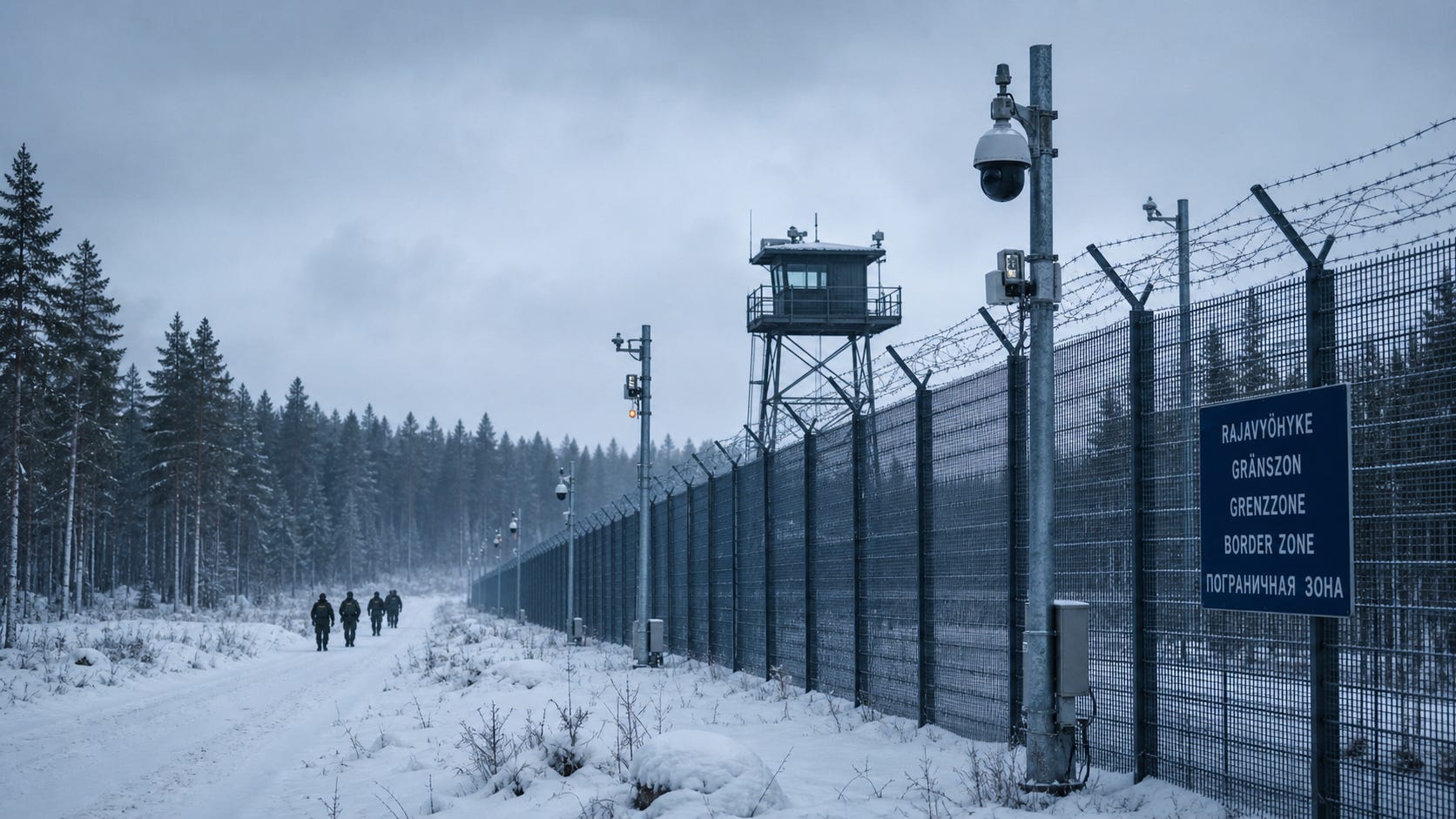
The fence itself, standing approximately 4.5 meters high and equipped with motion detection, cameras and communication systems, will ultimately cover only a fraction of the border.1 But that is deliberate. Finnish planners prioritise strategic choke points, where terrain and surveillance create a multiplier effect for limited personal.
Border guards, historically positioned as civilian law enforcement, are increasingly integrated into a “total defence” framework. The closure of all land crossings since December 2023 reinforces the logic, normalising a persistently securitised frontier.
From migration Crisis to Deterrence Doctrine
The catalyst for this transformation remains the 2023 migration episode, which Finnish authorities assess as deliberate hybrid pressure. The response has been structural rather than reactive. The Border Security Act extended through 2026 provided exceptional authorities to control flows and limit exploitation of legal grey zones. 2
The underlying lesson is clear: Low-cost, deniable pressure can generate disproportional disruption unless pre-emptively constrained.
“Finland is no longer preparing for ambiguity on its eastern border. It is preparing for conflict conditions.”
Operationalising Deterrence: NATO on the Northern Flank
This shift is increasingly visible in large-scale NATO exercises across the Arctic and the High North.
Since joining the alliance, Finland has participated in multinational drills spanning Norway, Sweden and Finland, testing the ability of allied forces to operate together in extreme cold-weather and high-intensity scenarios. Recent exercises have involved approximately 25,000 thousand troops from 14 nations, rehearsing territorial defence, rapid deployment and multi-domain operations in Arctic conditions. 3
![r/policeporn - Finnish Border Guard 1st Special Intervention Unit operator during an exercise.[1600x1066]](https://substackcdn.com/image/fetch/$s_!eIfA!,f_auto,q_auto:good,fl_progressive:steep/https%3A%2F%2Fsubstack-post-media.s3.amazonaws.com%2Fpublic%2Fimages%2Fd26cb940-8292-428c-9d8d-bf45f87da5c7_640x426.jpeg "r/policeporn - Finnish Border Guard 1st Special Intervention Unit operator during an exercise.[1600x1066]")
The United Kingdom (UK) has played a prominent role. Royal marines commandos , the UKs specialists in cold weather and amphibious operations, have deployed in significant numbers to the region, conducting reconnaissance , raids exercises and life-fire exercises as part of alliance planning. 4
These activities are explicitly framed as efforts to deter aggression on NATO’s northern flank. At the tactical level, such exercises enhance interoperability and readiness. At the strategic level, they serve as a visible demonstrations on allied cohesion, signalling that Finalnd’s defence is now embedded within a collective framework rather than a purely national one.
Second Order Effects : The quiet Breakdown of the Border Region
The deterioration in Finnish-Russian relations is also producing less visible consequences.
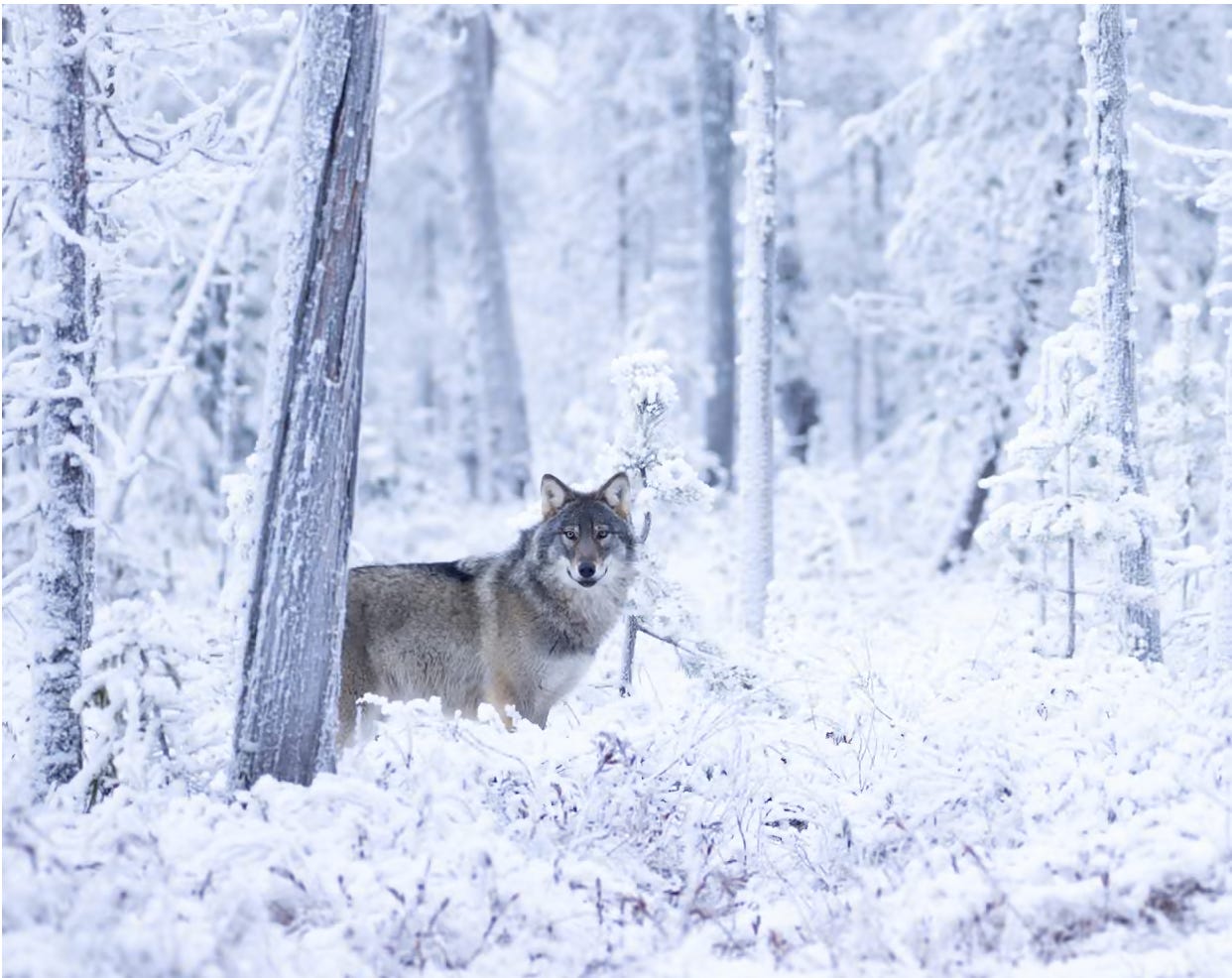
Cross-border cooperation has largely ceased, contributing to disruptions in local governance and economic activity. One example is the rise in wolf attacks on reindeer in northern Finland, with over 2,100 recorded loses in 2025, highlighting how geopolitical rupture can generate second-order effects in borderland systems.5
Strategic Outlook
Short term: Moderate confidence: Finland will continue expanding surveillance and maintaining strict border controls. Russian activity is likely to remain below the threshold of open confrontation, including cyber activity or hybrid probing.
Medium term: Moderate confidence: A stabilisation in Ukraine could allow Russia to reallocate attention to peripheral theatres, including the north, increasing signalling and pressure in Arctic regions.
Indicators to Watch
Renewed irregular movement from the Russian side.
Expansion of Finnish surveillance capabilities
Increased Russian military activity in northern regions
Further nuclear or strategic signalling
Bottom Line
Finland is not preparing for imminent war with Russia. But it is preparing for a security environment in which conflict conditions are increasingly plausable and ambiguity is weaponised.
The hardening of the eastern border, deeper NATO integration and the expansion of activity into the Arctic all point in the same direction: Finland now treats its frontier as a persistent zone of competition.
In that context, the Arctic is no longer a distant flank. It is a frontline.
https://tvpworld.com/90116338/finland-finishes-latest-stretch-of-high-tech-russia-border-barrier
https://fiia.fi/en/publication/russias-hybrid-operation-at-the-finnish-border
https://www.independent.co.uk/news/world/europe/arctic-war-greenland-cold-response-b2934606.html
https://www.royalnavy.mod.uk/news/2023/december/07/230712-finnish-exercise-finishes
https://www.theguardian.com/environment/2026/jan/24/finland-russian-wolves-blamed-record-reindeer-deaths-ukraine-war-aoe
Very good, particularly liked the mention of the wolves. Finnish mandatory service is great; it encourages a sense of nationhood and is taken seriously. They are also very aware of the Winter War in 39, 40 and will not let it repeat.
Excellent piece. Finland’s preparation should not be read simply as anticipation of imminent war, but as a model of deterrence through operational readiness.
In the Arctic, geography is not background. Distance, darkness, weather, sparse infrastructure, logistics, communications, mobility, and sustainment are part of the battlefield itself.
That is why NATO’s answer cannot be limited to more presence. It must be the ability to reinforce, disperse, survive, and fight coherently in an environment that naturally slows movement and decision-making.
Finland matters because it converts national geography, reserve depth, winter warfare expertise, territorial defence culture, and allied integration into deterrent credibility.
The Arctic front is therefore not a frozen periphery. It is a test of whether NATO can turn geography from a vulnerability into operational advantage.